
Franklin County Warrant Search Limits
Franklin County did not publish an official public active-warrant search page in the official sources captured for this build. That matters. A person should not assume a web search, a general court docket, or a private lookup result is enough to confirm whether a Franklin County warrant exists. The researched local process points to a fallback chain: check the issuing court, contact Magistrate Court for many warrant questions, contact Probate Court for traffic failure-to-appear issues, and use the Franklin County Sheriff's Office for law-enforcement and booking follow-up.
The county's own record-routing language also draws a line between court records and agency records. Judicial records should be requested from the court that keeps them. Sheriff's Office records, such as releasable arrest, incident, jail, or service records, may use the Sheriff's Office open-records process. For warrant records, that means the court can be the source for the warrant order or case status, while the sheriff can be the source for whether a person was arrested, booked, or served with process.
The Franklin County Magistrate Court page is the key local warrant source because it lists warrant jurisdiction. The county's captured pages do not show a public active-warrant roster, so direct contact remains the safest official route.
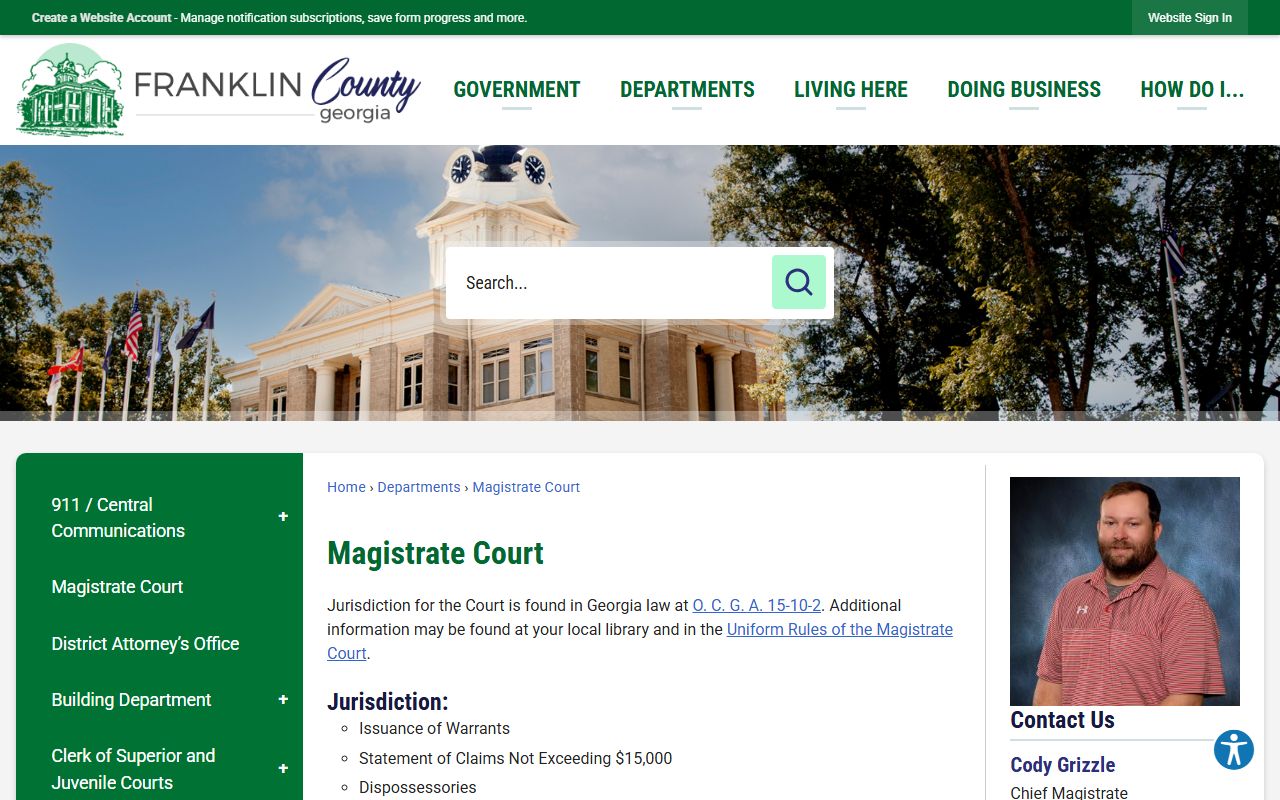
The Magistrate Court source supports the page's main point: Franklin County warrant checks are court-specific, not a single countywide web roster.
Franklin County Warrant Court
Magistrate Court is the first local court to understand for Franklin County warrant records. The research file lists Franklin County Magistrate Court at 7085 Highway 145, Suite B, Carnesville, GA 30521, phone 706-384-7473, fax 706-384-2296, with hours Monday through Friday, 8:00 a.m. to 4:30 p.m. Chief Magistrate Cody Grizzle and Judge Freddy Pulliam are listed in the county materials. The same local section states that the court handles warrants, small claims up to $15,000, dispossessories, garnishments, FIFAs, bad checks, county ordinance matters, limited misdemeanors, subpoenas, writs, and hearings.
Georgia law also supports this routing. O.C.G.A. 15-10-2 describes Magistrate Court jurisdiction, including warrant and listed limited civil and criminal matters. For a Franklin County warrant tied to an arrest, search, deposit-account fraud matter, county ordinance case, or Magistrate Court hearing, calling Magistrate Court is usually more direct than starting with the Superior Court docket.
Franklin County Magistrate Court
7085 Highway 145, Suite B
Carnesville, GA 30521
706-384-7473
Monday-Friday, 8:00 a.m.-4:30 p.m.
Franklin County Warrant Follow-Up
The Franklin County Sheriff's Office handles law-enforcement functions after a warrant is issued, including patrol, criminal investigations, jail operations, courthouse security, civil process, and arrest or booking steps when a warrant is served. The Sheriff's Office and Detention Center use 1 James Little Street and P.O. Box 310, Carnesville, GA 30521. The main phone number located in the research is 706-384-2525, and the fax number is 706-384-4886.
Sheriff Scott Andrews' office is the local agency for law-enforcement records that are not court records. Franklin County's Sheriff's Office open-records page states that the office will notify requesters within three business days if responsive records exist and whether the records are subject to release. It also lists copy and labor rules. Black-and-white letter or legal copies are $0.10 per page, and search, retrieval, redaction, and supervision labor may be charged at the hourly rate of the lowest paid qualified full-time employee, with no charge for the first 15 minutes.
| Channel | Use It For | Important Limit |
|---|---|---|
| Magistrate Court | Many arrest, search, bad-check, ordinance, and hearing-related warrant questions. | No public online active-warrant field list was captured. |
| Sheriff's Office | Service, arrest, booking, jail, and releasable law-enforcement records. | The office cannot release records it does not have or records barred by law. |
| Probate Court | Traffic failure-to-appear and late-payment consequences for Probate traffic citations. | Some citation issues require in-person or mail handling. |
| Superior Court | Felony case warrants, bond status, and pending criminal case files. | Use the Clerk of Superior and Juvenile Courts for court-file access. |
Franklin County Traffic Warrants
Traffic warrants and failure-to-appear consequences can follow a different path. Franklin County's official traffic page is under Probate Court, and it states that mandatory-appearance citations require a court appearance. Late traffic payments must be handled in person or by mail. For driver-license reinstatement, most DMVs require a DS-912 form or reinstatement letter, so a person dealing with a late Franklin County traffic citation should ask Probate Court what proof is needed and how it will be issued.
For traffic cases, the county says many citations can be paid through EZCourtPay, but a citation may take 7 to 10 business days from the citation date to become available online. After that window, the user should contact the court for citation status. A traffic failure to appear may lead to court and license consequences, but the captured sources do not publish a public traffic bench-warrant roster. A not-guilty plea, contest, or jury demand in a Probate traffic matter can also move the case path, because jury-trial requests transfer to Franklin County Superior Court.
Important: A warrant check can lead to arrest or license action, so call the issuing court before appearing in person.
Franklin County Warrant Fields
No official Franklin County active-warrant portal fields were captured. The better search-field table for this county is therefore a request-preparation table. These are the fields a court clerk or sheriff records custodian is likely to need to identify the correct person and case without guessing. Use only facts known to the requester. If the requester does not know the issuing court, start with the type of matter, such as Magistrate Court warrant, Probate Court traffic case, Superior Court criminal case, or city citation.
| Field or Detail | Type | Required | Notes |
|---|---|---|---|
| Full legal name | Text | Usually yes | Give prior names or spelling variants when relevant. |
| Date of birth | Date | Often needed | Helps avoid confusing people with the same name. |
| Issuing court | Court name | If known | Magistrate, Probate, Superior, or municipal court may hold the record. |
| Case, citation, or warrant number | Text | If known | Use the exact number from a notice, citation, bond paper, or court entry. |
| Charge or case type | Description | No | Examples include traffic failure to appear, bad check, arrest warrant, or probation issue. |
For the staff-directory view of Magistrate Court, use the county's Magistrate Court directory entry. The entry reinforces the same Carnesville court address and business-hour routing for warrant questions.
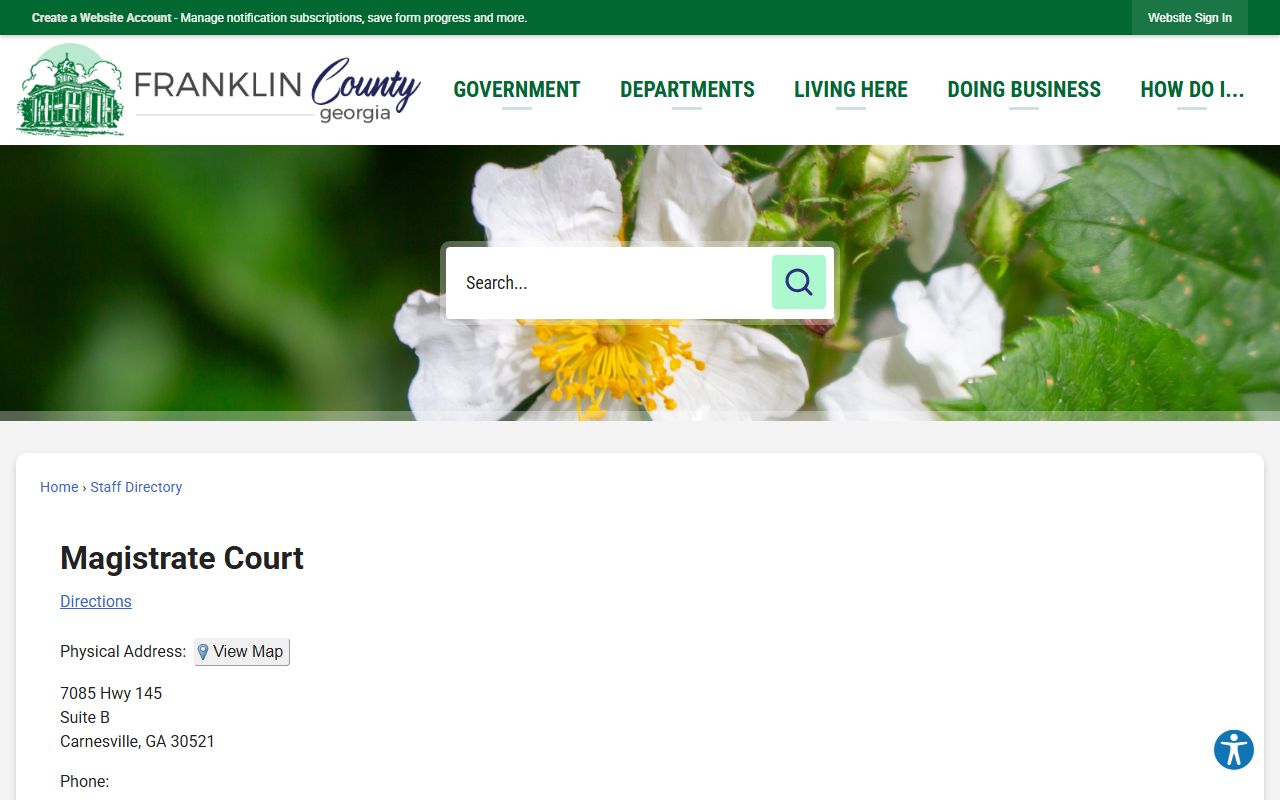
The directory image supports the practical search path: use Magistrate Court contact details when the warrant source is not available through a public database.
Franklin County Warrant Record Details
A Franklin County warrant record can show different details depending on whether it is a court order, a law-enforcement service record, a traffic failure-to-appear entry, or a criminal case docket entry. The research does not provide a sample Franklin County warrant result, so the record inventory should be read as a request checklist, not a promise that every field is public or present in every case.
| Field | What It Shows |
|---|---|
| Subject name and date of birth | The person the warrant concerns, used to avoid mistaken identity. |
| Warrant type | Arrest, search, bench, probation, traffic failure to appear, bad-check, or another category. |
| Issuing court | Magistrate, Probate, Superior, municipal, or another court with authority over the matter. |
| Case or warrant number | The identifier staff use to retrieve the court order or case file. |
| Charge or basis | The alleged offense, missed court event, probation issue, or court order behind the warrant. |
| Bond and status | Bond amount or type if set, plus active, served, recalled, quashed, cleared, or similar status when available. |
Resolve Franklin County Warrants
Resolving a Franklin County warrant is not the same as deleting a web result. The court that issued the warrant controls recall, clearance, appearance, payment, compliance proof, or judge review. A sheriff's arrest or booking record may show that a warrant was served, but the court record is usually needed to confirm that the warrant was recalled or the case has been reset.
- Do not appear at a courthouse or sheriff's office without understanding that arrest may occur.
- Call the issuing court first if known, using Magistrate Court for many warrant questions and Probate Court for Probate traffic matters.
- If the warrant is tied to a criminal case, check the full case status through the Clerk of Superior and Juvenile Courts or counsel of record.
- Ask whether recall is possible through payment, proof of compliance, a new court date, bond, or judge's order.
- After resolution, request written proof and ask how long the court and law-enforcement systems take to update.
For a deeper view of filed charges after an arrest, use the Franklin County arrest records and court charges page. Warrant status and charge filing are related, but they are not the same record.
Restricted Franklin County Warrants
Some Franklin County warrant information may be restricted, sealed, delayed, or redacted. Search warrants can be sealed during an investigation. Juvenile matters are handled under separate confidentiality and sealing rules. Personal identifiers, victim details, medical information, and protected minor information can be withheld. Georgia record restriction under O.C.G.A. 35-3-37 may limit public access to eligible criminal-history records, but it does not mean every court or law-enforcement copy disappears.
Franklin County's open-records routing is also important. The county says the judiciary is not handled through ordinary open-records requests, although many judicial records are open for public viewing. Use the court for court orders, bench warrants, and case entries. Use the Sheriff's Office process for releasable agency records. When a record cannot be released, ask which law, court order, or record status controls the denial or redaction.
Note: Municipal or city warrants may not appear in county Superior Court or Magistrate Court materials, so city-court checks may be needed.