
How to Search Franklin County Court Records
Franklin County points court users first to its Court Dockets page, which sends searches to the Franklin Clerk of Court webpage for docket access. That channel is the local doorway for Clerk of Superior and Juvenile Courts dockets. The live portal may use vendor or iframe tools, and the research capture did not expose a reliable field list. Treat the county link as the official starting point, then confirm field names and document access in the live portal before relying on a result.
Georgia also uses provider-based court access. The Georgia Courts e-access page explains that users may be sent to provider sites and may need an account to search court records. PeachCourt is a statewide filing and document channel for civil and criminal matters. For older files, certified copies, Probate Court vault records, or Magistrate Court files, direct contact with the court is still the stronger route.
- Identify the court level before searching: Superior, Juvenile, Probate, Magistrate, municipal, or sheriff records.
- Use the Franklin County docket page for Clerk of Superior and Juvenile Courts docket access.
- Check Georgia provider access or PeachCourt when the case requires account-based filing or document access.
- Call or visit the right court when the portal does not show the file, the case is old, or a certified copy is needed.
- Use the Sheriff's Office open-records process only for sheriff-held agency records, not judicial case files.
Franklin County's open-records routing page is important because it says judicial records should be handled through the court that created them. Many judicial records are open for viewing, but the judiciary is not routed through the same general open-records request process used for county departments.
Franklin County Courts by Record
Franklin County Superior Court is Georgia's broad trial court for felony cases, divorce and domestic relations, title-to-land disputes, equity matters, major civil cases, and jury-trial transfers. It is part of the Northern Judicial Circuit. The Clerk of Superior and Juvenile Courts keeps Superior Court and Juvenile Court filings, while Probate Court and Magistrate Court operate separate local counters with their own phone numbers and procedures.
Probate Court handles wills, estates, guardianships, marriage licenses, some vital-record duties, and certain misdemeanors and traffic matters when a jury trial is not requested. Magistrate Court handles warrants, small claims up to $15,000, dispossessories, garnishments, subpoenas, bad checks, county ordinance matters, and limited misdemeanors. Municipal courts may handle city citations or ordinances, but no countywide municipal search page was located in the official source set.
Case flow: local agency or filer › Magistrate, Probate, municipal, Juvenile, or Superior Court › jury-trial transfer when allowed › Georgia Court of Appeals or Supreme Court of Georgia when appellate rules apply.
| Court or office | Local contact | Record role |
|---|---|---|
| Superior Court | 9592 Lavonia Road, Carnesville; Clerk 706-384-2514 | Felony, divorce, domestic, land/title, equity, major civil, and transfers. |
| Juvenile Court | Clerk of Superior and Juvenile Courts | Juvenile files with strong access limits. |
| Probate Court | 7085 Highway 145 Suite A; 706-384-2403 | Estates, wills, guardianships, marriage licenses, vault records, traffic, and some misdemeanors. |
| Magistrate Court | 7085 Highway 145 Suite B; 706-384-7473 | Warrants, small claims, evictions, garnishments, bad checks, and ordinance matters. |
| Sheriff's Office | 1 James Little Street; 706-384-2525 | Jail, booking, incident, civil process, and sheriff open-records materials. |
Franklin County Court Offices
Franklin County court access is not a one-counter system. Superior and Juvenile files route through the Clerk of Superior and Juvenile Courts at the Lavonia Road address. Probate Court and Magistrate Court share the Highway 145 court-office location but use different suites. Sheriff and jail records route to James Little Street or the Sheriff's Office mailing address. District Attorney records and prosecution questions route separately to Athens Street.
Clerk of Superior and Juvenile Courts
9592 Lavonia Road
P.O. Box 70
Carnesville, GA 30521
706-384-2514
Monday-Friday, 8:00 a.m. to 5:00 p.m.
Probate Court
7085 Highway 145, Suite A
Carnesville, GA 30521
706-384-2403
Traffic payments in person Monday-Friday, 8:00 a.m. to 4:30 p.m.
Magistrate Court
7085 Highway 145, Suite B
Carnesville, GA 30521
706-384-7473
Monday-Friday, 8:00 a.m. to 4:30 p.m.
Franklin County Court Record Types
Franklin County court records include civil pleadings, felony criminal cases, domestic relations, juvenile matters, probate files, magistrate civil and warrant matters, traffic citations, marriage records, divorce decrees, and sheriff-held booking or incident materials. The record type controls where a search should begin. A divorce decree belongs with the Superior Court clerk. A will or estate file belongs with Probate Court. A warrant may involve Magistrate Court and the Sheriff's Office. A traffic citation may start in Probate Court and move to Superior Court if a jury trial is requested.
- Superior Court civil and domestic files: complaints, answers, motions, orders, judgments, divorce decrees, custody matters, and title-to-land cases.
- Superior Court criminal files: felony accusations or indictments, arraignment entries, plea paperwork, motions, verdicts, disposition, and sentencing orders.
- Probate Court files: wills, estates, guardianships, marriage licenses, vital-record duties, and older vault records dating back to the late 1800s.
- Magistrate Court files: warrants, small claims, dispossessories, garnishments, subpoenas, bad checks, and county ordinance matters.
- Traffic and sheriff records: Probate Court citation records, EZCourtPay payment status, jail, booking, and sheriff open-records materials.
The Georgia Superior Courts FAQ is a useful statewide reference for the difference between Superior, State, Magistrate, and Probate courts. Franklin County's local mix matters most, because the county did not identify a State Court page for local record searches.
The Georgia court hierarchy image source in the manifest came from that statewide FAQ. It supports the local rule that Franklin County Superior Court, Probate Court, and Magistrate Court should not be treated as one database.
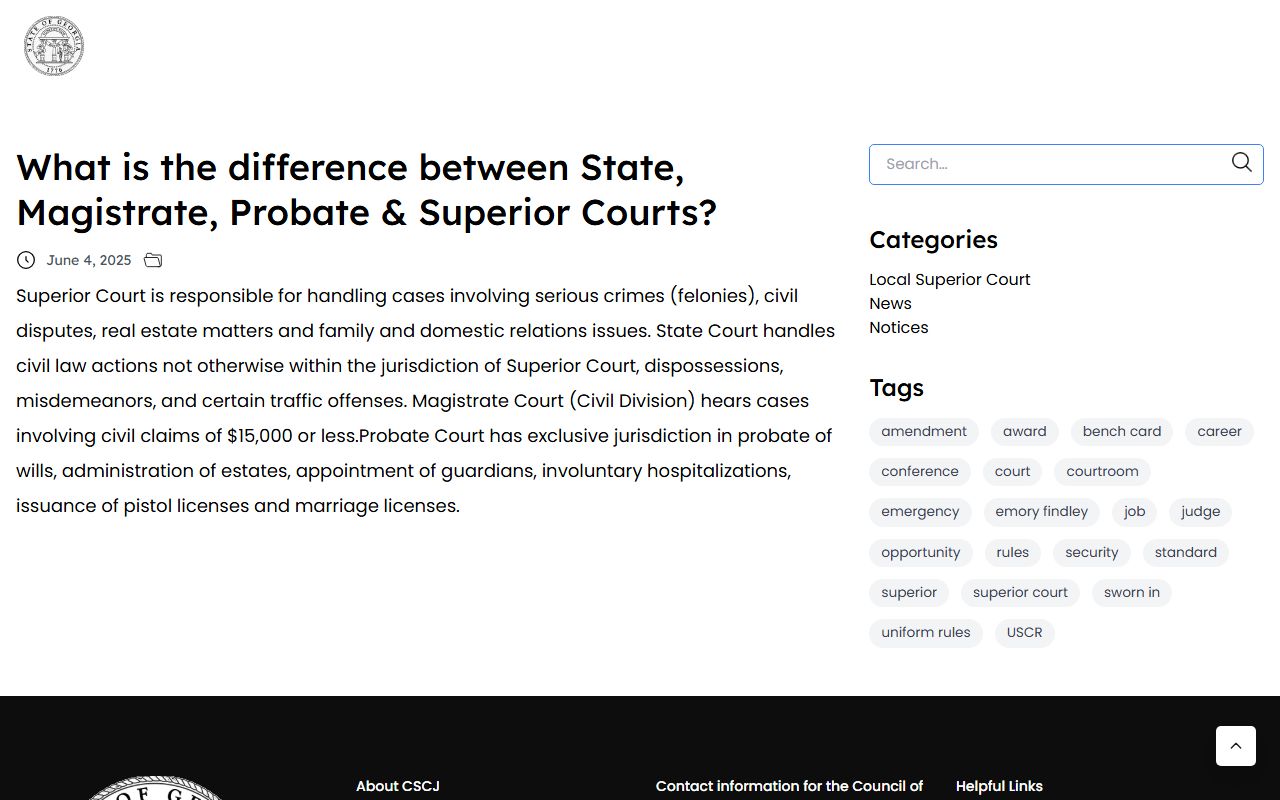
The statewide court explanation is most useful when paired with Franklin County's own office list, because the local clerk, Probate Court, Magistrate Court, and Sheriff each hold different records.
What Franklin County Court Records Show
A Franklin County court record can show the court and division, case number, filing date, party names, attorney names, docket events, pleadings, hearing dates, orders, judgments, dispositions, and financial entries. Criminal records may add charge descriptions, accusations or indictments, bond entries, plea and sentence data, probation terms, fines, restitution, and post-judgment filings. Probate files may show estate name, decedent, petitioner, will filings, guardianship petitions, inventories, notices, orders, and final accounting when public.
| Field | What it means in Franklin County searches |
|---|---|
| Case number | The local court identifier. The research did not locate an official Franklin County format, so do not infer one from other systems. |
| Court and division | Superior, Juvenile, Probate, Magistrate, or a municipal court if the matter is city-based. |
| Parties | Plaintiff and defendant, State of Georgia and defendant, petitioner and respondent, or estate and petitioner. |
| Docket entries | Filed pleadings, motions, continuances, hearings, orders, judgments, transfers, dismissals, and appeals. |
| Disposition | The final outcome, such as dismissed, nolle prosequi, judgment, guilty plea, verdict, sentence, or closed. |
| Restrictions | Juvenile, sealed, adoption, mental-health, protected minor, and redacted personal data may not be public. |
Franklin County Court Access Rules
Georgia public-records law favors access to public records, but Franklin County's local court instructions draw a firm line between agency records and judicial records. O.C.G.A. 50-18-70 states the public-access policy. O.C.G.A. 50-18-71 covers response and cost rules for open-records requests. Those statutes help with sheriff and county agency records, but court files often require direct court contact instead of a generic open-records form.
Key Statutes:
O.C.G.A. 50-18-70 - Georgia law favors public access unless a specific law or court order restricts a record.
O.C.G.A. 35-3-37 - Georgia record restriction can limit public access to eligible criminal-history records.
O.C.G.A. 15-10-2 - Magistrate Court jurisdiction includes warrants, small claims, bad checks, and listed civil and criminal matters.
O.C.G.A. 31-10-25 - County marriage certificates, applications, divorces, dissolutions, and annulments are public with listed exceptions.
Franklin County's countywide open-records page is useful as a routing map. It lists the Clerk of Superior Court, Magistrate Court, Probate Court, and Sheriff's Office separately. For Probate and Magistrate matters, it says to contact the court or submit the proper documentation and payment for statutory costs directly to that court.
The Justia public-records source in the manifest documents Georgia's public-records policy. It belongs with Franklin County court access because it explains the default access rule, while the county's own page explains where court users must actually send requests.
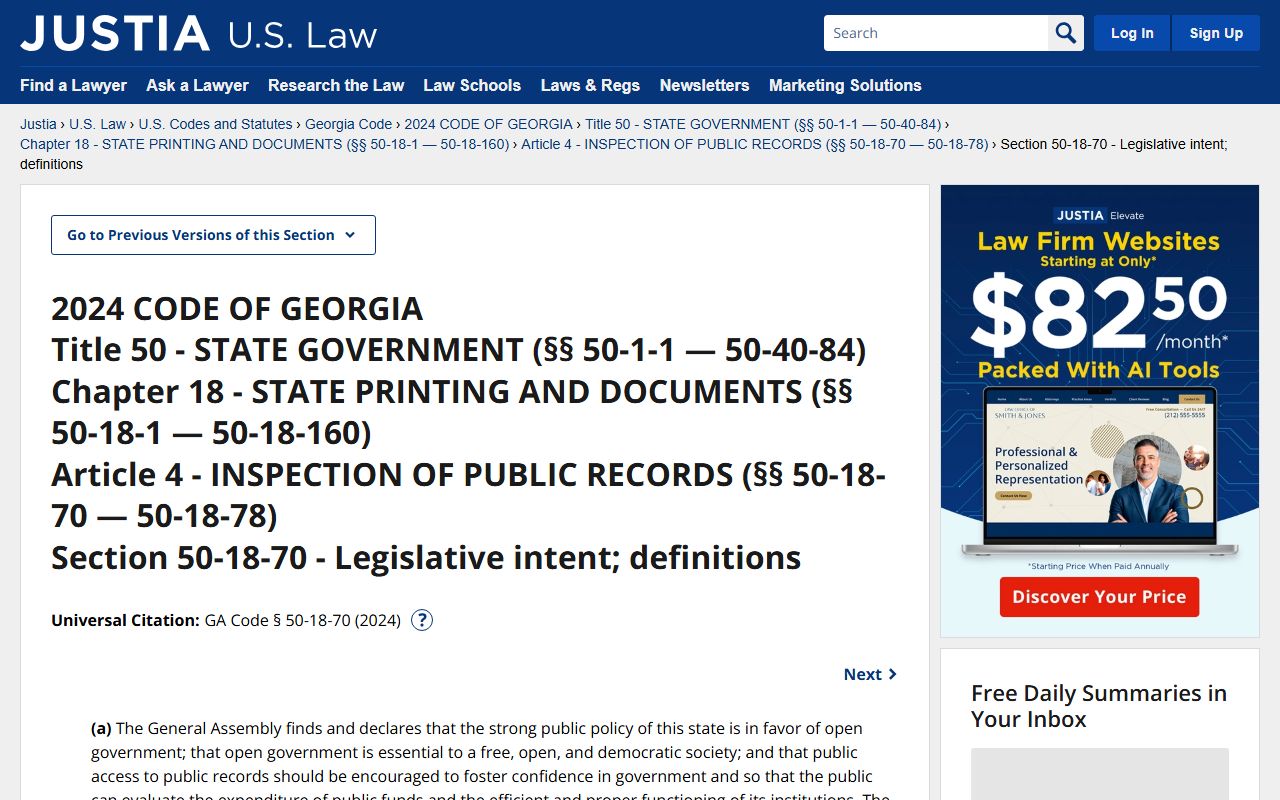
That state law backdrop does not replace Franklin County's court-specific routing. Superior, Probate, and Magistrate records still need the right court office.
Franklin County Sheriff and Jail Records
The Franklin County Sheriff's Office is led by Sheriff Scott Andrews, who took office in January 2025. The office describes itself as the county's primary law-enforcement agency and serves more than 23,000 citizens across 256 square miles. Its duties include uniform patrol, criminal investigations, narcotics investigations, jail operations, courthouse security, and civil process. Sheriff records are not the same as court records, but they often connect to warrants, arrests, inmate custody, and charges filed after arrest.
The county Detention Center page did not publish an online jail roster field list in the captured official text. For county jail detainees, the official local fallback is the Sheriff's Office phone number or a sheriff open-records request for releasable booking and jail records. The Georgia Department of Corrections offender search is a state-prison and sentenced-offender tool, not a full Franklin County jail roster.
The Franklin County open-records routing image came from the official county page. It supports a practical split: sheriff-held reports, booking records, and jail materials route through the Sheriff's Office, while judicial case files route to the court that created them.
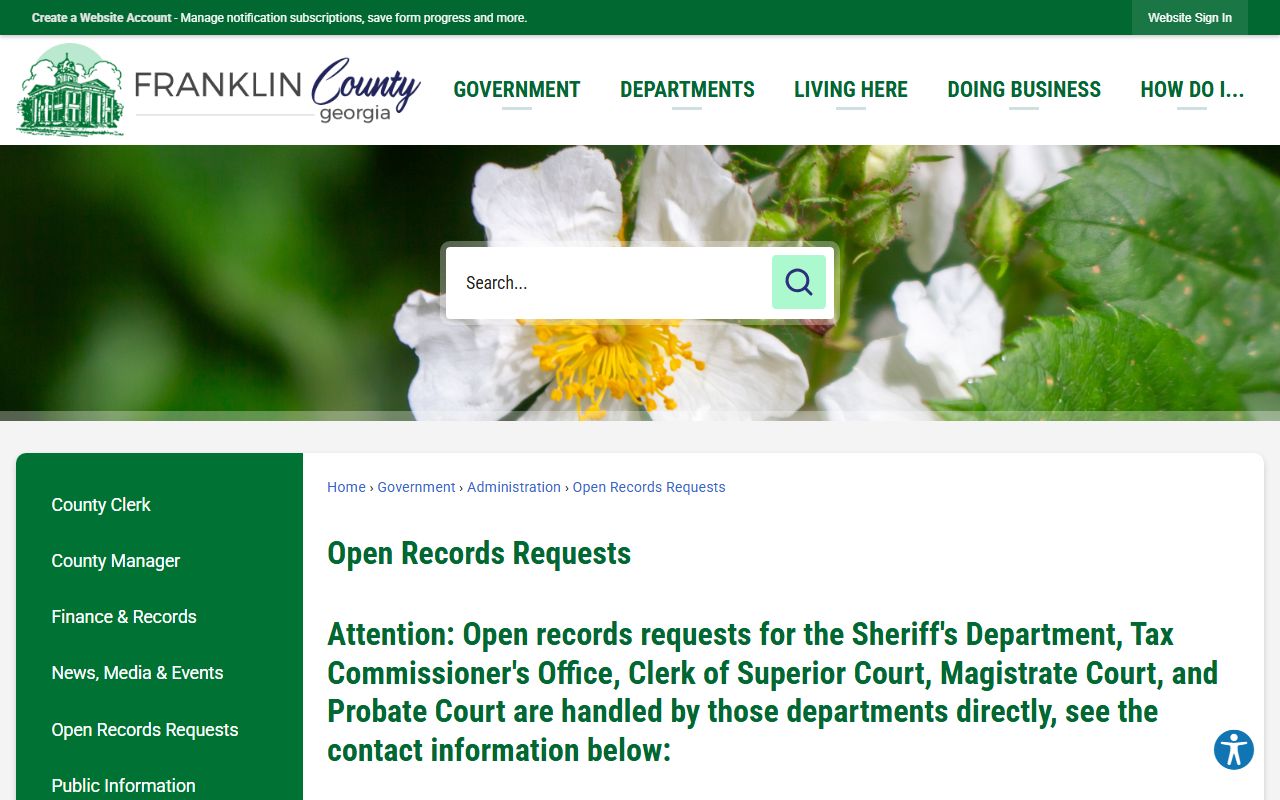
The Sheriff's Office open-records page adds that the office responds within three business days if responsive records exist and whether they are releasable.
Franklin County Probate and Marriage Records
Franklin County Probate Court has unusually important historical record value because the county says probate records date back to the late 1800s and are kept in the court vault. Probate Court handles wills, estates, guardianships for minors and adults, involuntary hospitalization proceedings, marriage licenses, firearms licenses, vital-record duties, certain misdemeanors, traffic cases, and game and fish violations unless a jury trial is requested.
Marriage licenses are handled by Probate Court. Franklin County states that applicants seeking the reduced fee must bring a signed, verified, and dated premarital education certificate. The minimum marriage age is 17, and a 17-year-old applicant must satisfy emancipation, timing, age-gap, and premarital education requirements. Divorce decrees and domestic case files are Superior Court records, not Probate Court records.
- Probate
- The court process for wills, estates, guardianships, and related orders.
- Executor
- A person named or approved to carry out estate duties under court authority.
- Intestate
- A case where a person died without a valid will controlling estate distribution.
- Guardianship
- A Probate Court appointment to protect a minor or adult who needs court-supervised help.
The Franklin County history page explains the county's early formation, while the Probate Court source explains the late-1800s vault records that matter for estate and marriage research.
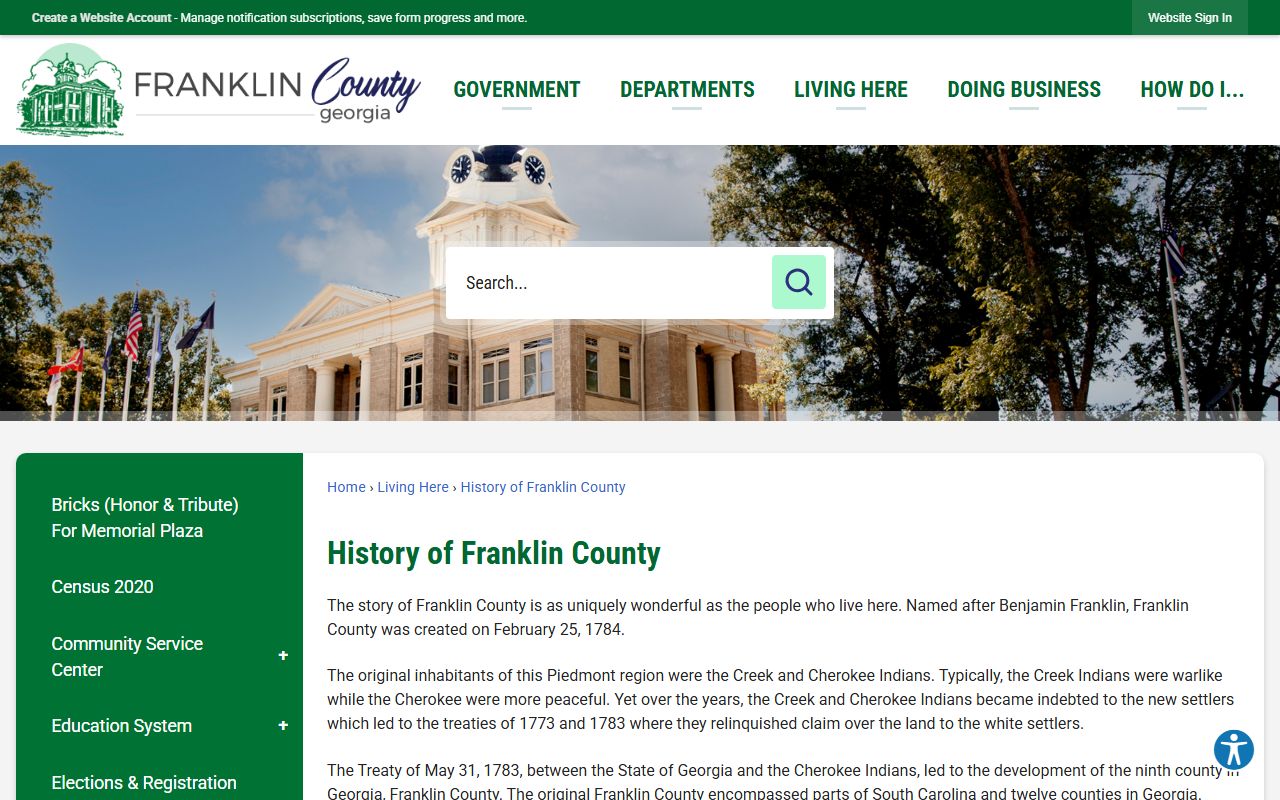
That history is a records-access fact, not just local color, because older Franklin County probate and marriage records may require a vault request rather than a web search.
Franklin County Traffic Court Records
Franklin County's traffic process is centered on Probate Court for many citations. The county traffic page says most traffic violations may be paid online through EZCourtPay. It also says citations may take 7 to 10 business days from the citation date to appear online. If the citation is still hard to find after that window, the county directs users to EZCourtPay phone support at 800-262-0128 between 7:00 a.m. and 9:00 p.m. Eastern, Monday through Friday.
Some citations require appearance. Franklin County lists DUI, driving while suspended or withdrawn, no driver's license second or greater offense, marijuana possession, fleeing or attempting to elude, underage alcohol possession, certain charge combinations, hunting and fishing violations, and under-21 speeding of 24 mph or more above the limit. A not-guilty plea is entered at arraignment, a hearing is set later, and jury-trial requests transfer to Superior Court.
| Traffic option | Franklin County rule |
|---|---|
| Online payment | Use EZCourtPay for most eligible Probate Court traffic violations. |
| In-person payment | Cash, credit card, or money order at Probate Court during posted payment hours. |
| Mail payment | Money order or certified check payable to Franklin County Probate Court before the court date. |
| Late payment | Must be handled in person or by mail and may require a DS-912 reinstatement letter. |
| Contest | Appear at arraignment, enter a not-guilty plea, and follow the later hearing process. |
Franklin County Court Record Fees
Franklin County research did not locate a full official clerk copy-fee schedule for Superior Court certified and plain court copies. That gap should not be filled with guessed fees. The safer access path is to call the Clerk of Superior and Juvenile Courts before ordering copies, then confirm whether the record can be searched online, copied at the counter, mailed, or certified for legal use.
| Item | Amount or rule |
|---|---|
| Clerk certified or plain court-copy fees | Not located in official Franklin County source; call 706-384-2514. |
| Sheriff black-and-white letter or legal copies | $0.10 per page. |
| Sheriff search, retrieval, redaction, or supervision labor | Hourly rate of the lowest paid qualified full-time employee; first 15 minutes free. |
| Probate and Magistrate statutory costs | Payment required when applicable, but amount not listed on the routing page. |
| Traffic fines | Amount depends on citation; use EZCourtPay or Probate Court. |
Georgia's open-records cost rule explains response and cost principles for agency records. For Franklin County judicial records, the court counter remains the best place to confirm copy and certification charges.
The cost rule helps explain sheriff request fees, but it does not supply a missing Franklin County court-copy fee schedule.
Restricted Franklin County Court Records
Not every Franklin County court record is open in the same way. Juvenile Court materials are substantially restricted. Adoption records are not treated like public divorce or custody records. Involuntary hospitalization and sensitive guardianship records from Probate Court can involve medical or protected personal information. Criminal records may be sealed or restricted under Georgia's record-restriction statute, and online tools may omit information that remains available to courts or criminal-justice agencies.
Personal identifiers can also be redacted. Social Security numbers, financial-account data, protected minor information, medical details, victim-identifying facts, and sealed case material should not be expected in a public docket result. A person asking about adult criminal record restriction should check the arresting agency, prosecutor, and court outcome. A juvenile issue uses juvenile sealing and confidentiality rules, not the same public path as an adult case.
Note: Record restriction limits public access in Georgia, but it does not always destroy every government copy of a record.
Federal Court Records for Franklin County
Federal cases from Franklin County are not filed in Franklin County Superior, Probate, or Magistrate Court. Federal civil, criminal, bankruptcy, habeas, civil-rights, tax, agency, and diversity cases route through the federal court system. The U.S. District Court for the Northern District of Georgia handles non-bankruptcy federal trial cases, the U.S. Bankruptcy Court for the Northern District of Georgia handles bankruptcy, and appeals from the district go to the Eleventh Circuit.
PACER is the official federal electronic access system. It requires account access and may charge fees. CourtListener can be useful for some free federal opinions and docket material, but it is not the official record custodian and may not include all filings.
The manifest image from CourtListener is included as a federal alternative reference. It is helpful for some federal research, while county Superior, Probate, Magistrate, traffic, jail, and warrant records remain with Franklin County or Georgia agencies.
Use PACER for official federal documents, then return to Franklin County offices for local court and sheriff records.
Franklin County Court Records FAQ
Where do Franklin County court records start?
Start with the court that created the case. Superior and Juvenile records route to the Clerk of Superior and Juvenile Courts. Probate files route to Probate Court. Magistrate warrants and small claims route to Magistrate Court. Sheriff booking and jail records route to the Sheriff's Office.
Is there one Franklin County public court database?
No official source found one single database for every Franklin County court record. The county docket page, Georgia e-access, PeachCourt, EZCourtPay, court counters, and sheriff requests each cover different tasks.
Who has Franklin County divorce records?
Divorce records are Superior Court records. Certified divorce decrees should be requested from the Clerk of Superior and Juvenile Courts where the divorce was granted, not Probate Court.
Who has Franklin County marriage records?
Marriage licenses and certificates route to Probate Court. Georgia Archives guidance also points post-1900 marriage records back to the Probate Judge of the county where the marriage is recorded.
How are Franklin County warrants checked?
No official public active-warrant search page was located. Magistrate Court is the main warrant-issuing court, and the Sheriff's Office handles law-enforcement follow-up and jail custody after service.
Are Franklin County jail records in the GDC search?
GDC searches sentenced state offenders. County jail detainees should be checked through the Franklin County Sheriff's Office or releasable sheriff records, because the county jail roster was not published in the captured official text.